Usuba vs Nakiri, and the Other Kitchen Knives People Mix Up
The usuba is sharpened on one side for professional cuts, the nakiri on both for everyday chopping. Here's that pair, and the other knives that look alike and aren't.
We earn a commission when you buy through our links, at no extra cost to you. How that worksAmazon prices as of Nov 7, 7:17 AM ET, subject to change. Details
For chopping a mountain of vegetables in a home kitchen, get a nakiri, not an usuba. Both are tall, flat, thin Japanese vegetable knives that look almost identical on a shelf, but the usuba is sharpened on one side only, for chefs who shave a daikon into a paper-thin sheet, and the nakiri is sharpened on both sides like the knives you already own. My pick is the Mercer Genesis nakiri, about $45. It's a second knife next to your chef's knife, worth buying if vegetables are most of what you cut.
Further down, the other pairs that get confused in the knife aisle: paring, utility and petty knives, the nakiri against a chef's knife, the rectangular Chinese knife, cleavers and butcher knives, and the carving knife.
Usuba vs nakiri: one bevel or two
The difference is the edge. An usuba is ground on one side only (the Japanese call this a kataba edge), and the back is flat, with a slight hollow on the best ones. That lets it cut thinner slices than a two-sided edge, which is why Japanese restaurant cooks use it for katsuramuki, turning a peeled cucumber or radish around against the blade until it unrolls into one long sheet. It also takes more skill to use well, which is why it's thought of as a professional's knife.
A nakiri is sharpened on both sides (ryōba), so it goes straight down where you aim it. It's the Japanese vegetable knife meant for home cooks, usually 6 to 8 inches long, with either a square tip (the Tokyo style) or a slightly rounded one (the Osaka style). Neither knife is for bones; both are far too thin.
A few more things that matter if you're thinking about an usuba:
- It's handed. Most are sharpened for a right-handed cook, and lefties have to order a left-handed one specifically. A nakiri works in either hand.
- It's heavier than a nakiri, though still much lighter than a fish-cleaving deba.
- It costs more. A forged usuba from a Japanese maker can run past $400 (Masamoto's 180 mm is about $445), against about $45 for a good German-steel nakiri.
- It sharpens differently. A one-sided edge needs its own method on the whetstone (the steps in my sharpening guide are for knives ground on both sides).
So unless you plan to learn the classic Japanese vegetable cuts, the nakiri is the one. It does everything you'd want an usuba for at home, and you can hand it to anyone in the house.
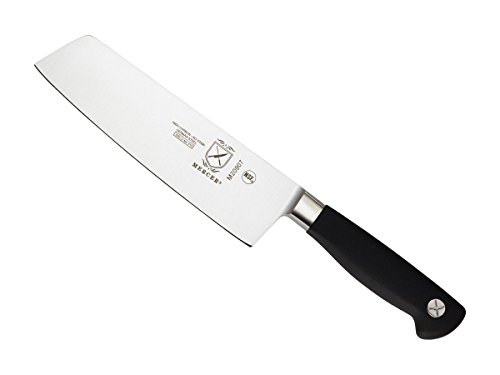
If you'd rather have a Japanese-made nakiri, the Shun Classic nakiri is about $190, has a 16-degree edge, and Shun sharpens its knives for free.
Nakiri vs chef's knife
A chef's knife has a curved edge and a pointed tip, so you rock it: the tip stays on the board and the heel goes up and down through a pile of parsley. Eight inches is the most common size. A nakiri's edge is flat, so the whole length meets the board at once. You push it straight down, and slices of celery come apart cleanly instead of hanging together by a thread at the bottom.
What the nakiri can't do is anything with a point: no scoring a pork shoulder, no tipping into the corner of a jalapeño to scrape the seeds. That's why it's a second knife, not a replacement. I'd buy one if most of your cooking is vegetables (stir-fries, big pots of soup, salads for four), and skip it if your chef's knife already feels right.
Kiritsuke vs nakiri or chef's knife
The traditional kiritsuke is a long, flat knife with the height of an usuba and an angled tip, 9 to 12 inches, and in Japan it's a knife for experienced chefs because the height and length take real control. The kiritsuke you'll see in American stores is different: Shun's, for example, comes in 8 and 6 inches and works in either hand. Think of that one as a chef's knife with a flatter edge and a sharp angled point. Next to a nakiri it has the point you'd miss, though you rock it less than a curved chef's knife.
Bunka vs chef's knife
A bunka is a version of the santoku (a knife usually 5 to 7 inches long, with a fairly flat edge) with an angled, pointed tip instead of the santoku's rounded one. Next to a standard 8-inch chef's knife it's a shorter blade that suits a small cutting board, and the angled tip gives you a point for fine work. If you rock-chop herbs a lot, you'll miss the chef's knife's curve.
Paring knife vs utility knife vs petty knife
A paring knife is the small one, 2 to 4 inches, made for work in your hand: peeling an apple, coring strawberries, deveining shrimp. A utility knife sits between paring and chef's knife at 4 to 7 inches, for jobs on the board that are too small for an 8-inch blade, like slicing a lime or a single shallot. A petty knife is the Japanese version of that same middle size, also 4 to 7 inches.
America's Test Kitchen (ATK) points out that the lines have blurred. Utility knives used to be long and narrow, petty knives triangular with a straight edge and thin, hard steel, but many knives sold today could pass for either. ATK's advice is to buy by what you want to cut, not by the name on the box.

If you have a chef's knife, I'd buy a paring knife first, because nothing else peels in your hand. the Victorinox paring knife is about $8, and Victorinox lets it go in the dishwasher. Add a petty or utility knife later if you find yourself pulling out the big knife for a single tomato. ATK's favorite petty was a Tojiro too, in a different steel.
Chinese cleaver vs chef's knife
The rectangular "Chinese cleaver" in most Chinese home kitchens isn't a cleaver at all. It's a Chinese chef's knife (caidao), a general-purpose knife about as thin as a Western chef's knife, and most makers warn you not to chop bones with it because the edge will chip. In China these knives come in three weights: slicers for vegetables and thin strips of meat, choppers that handle small, soft bones like fish and chicken, and true cleavers for pork ribs and lobster shells.
Against a chef's knife, the Chinese one gives you a wide blade that keeps your knuckles off the board and doubles as a scoop to carry chopped ginger and scallions to the wok. It has a gentle curve, so you can still rock it a little. What it doesn't have is a pointed tip. People who cook Chinese food every night often stop reaching for anything else; if you mostly roast and sauté, a chef's knife is easier to get along with. the Mercer Chinese chef's knife, about $33, sits closer to the chopper: Mercer says it handles thin or soft bones and hard squash.
Meat cleaver vs butcher knife vs chef's knife
A meat cleaver is heavy and thick from the spine almost to the edge, so you split bone with one sharp blow instead of slicing. The one that comes in a home knife block is usually a lighter-duty 6-inch blade, often with a hole in the corner for hanging.
"Butcher knife" is the confusing one. Most of the time, especially when you're shopping online, it just means a meat cleaver, and plenty of listings are titled "Meat Cleaver Butcher Knife." In a butcher shop it can also mean a long knife made for cutting through big pieces of raw meat. Either way, it's built for meat and nothing else.
A chef's knife is lighter, 8 to 10 inches, with a point, and it's the knife for everything except bones. If you break down ribs or a whole duck often, a cleaver is worth a drawer slot. For a chicken, the chef's knife through the joints is enough.
Chef's knife vs carving knife
A carving knife is longer (8 to 15 inches) and much thinner than a chef's knife, especially along the spine, so it pulls through a roast in one long stroke and leaves thin, even slices instead of thick, ragged ones. That's the whole difference, and you'll notice it on Thanksgiving turkey, a holiday ham or brisket. A slicing knife is similar but narrower and usually more flexible, often with little dimples along the blade to keep slices from sticking. For a roast chicken on a Tuesday, a sharp chef's knife does fine.
What you need
- Mercer Culinary Genesis Nakiri The nakiri for everyday vegetable chopping.$45.00
- Victorinox Swiss Classic Paring Knife The paring knife for peeling and coring in your hand.$8.00
- Tojiro DP Petty Knife The petty, for small jobs on the board.$89.00
- Mercer Culinary Chinese Chef's Knife The Chinese chef's knife, if you cook at the wok.$31.99
If you're deciding between an usuba and a nakiri for a home kitchen, get the Mercer Genesis nakiri: two-sided, easy to sharpen, about $45. If you want to learn katsuramuki and other Japanese restaurant cuts, that's the one time an usuba makes sense, and it's worth buying a good one sharpened for your hand.