Sunday Stove

The Best Knife Sharpeners

Get your chef's knife, santoku and bread knife sharp again, with a machine that does it for you or a stone you learn on, from about $12 to $166.

By Nell Harlan · Updated Oct 15, 202624 sharpeners compared

We earn a commission when you buy through our links, at no extra cost to you. How that works

A dull chef's knife slides through a ripe tomato again after two minutes in the Trizor XV, the sharpener I'd buy for most kitchens. It's electric, about $166, and you just draw the blade through three slots in order. Diamond wheels do the work and spring guides hold the angle, so there's nothing to learn.

The Pronto is the manual version from the same company, two diamond slots for about $41, and it fits in the utensil drawer. For about $12, the AccuSharp gets a dull knife cutting again in a few strokes. If you'd like to set the exact angle for every knife you own, get the Precision Adjust, and if you want to learn to sharpen by hand, start on the King whetstone.

Our picks

Best overallChef'sChoice Trizor XV Electric Knife SharpenerCheck price on Amazon
Best manualChef'sChoice Pronto Manual Knife SharpenerCheck price on Amazon
Best under $15AccuSharp Gourmet 15 Degree Knife SharpenerCheck price on Amazon
Best guidedWork Sharp Precision Adjust Knife SharpenerCheck price on Amazon
Best rollingWork Sharp Rolling Knife SharpenerCheck price on Amazon
Best whetstoneKing 1000/6000 Combination WhetstoneCheck price on Amazon

At a glance

  1. Best for
    Most home kitchens
    Type
    Electric, 3 stages
    Angle
    15°
    Effort
    About 2 minutes, no skill needed
  2. Best for
    A drawer and a small budget
    Type
    Manual pull-through, 2 stages
    Angle
    15°
    Effort
    Quick, no skill needed
  3. Best for
    Touch-ups for about $12
    Type
    Handheld, 1 stage
    Angle
    15°
    Effort
    Seconds
  4. Best for
    Any angle, paring knife to hunting knife
    Type
    Manual, clamp and guide rod
    Angle
    15° to 30°
    Effort
    Slower, takes practice
  5. Best for
    Quiet sharpening at the counter
    Type
    Rolling, magnetic block
    Angle
    15°, 17°, 20° or 25°
    Effort
    A minute or two to touch up
  6. Best for
    Learning to sharpen by hand
    Type
    Water stone, 2 sides
    Angle
    Whatever you hold
    Effort
    The most practice

Electric, pull-through, rolling or whetstone

There are four kinds of knife sharpener you'll see for a home kitchen. An electric sharpener spins abrasive wheels inside slots that hold the knife at the right angle; you pull the blade through and it's done. A pull-through (or manual) sharpener works the same way without the motor, so it's slower and smaller. A rolling sharpener sticks the knife to a magnetic block set at an angle, and you roll a disc of abrasive back and forth along the edge. A whetstone is a flat block you soak and slide the knife across by hand, holding the angle yourself.

Before any of that, find out your knife's angle. Older German and American knives usually left the factory at about 20 degrees on each side, while Japanese knives and most knives made in the last decade sit closer to 15. Half the sharpeners here are fixed at 15. America's Test Kitchen's advice is to keep a knife at the angle it was made for, because the steel was chosen to suit it. If the box or the maker's website doesn't say, their customer service will.

The 6 knife sharpeners, ranked

1 · Best overall
Chef'sChoice Trizor XV Electric Knife Sharpener

Chef'sChoice Trizor XV Electric Knife Sharpener

Diamond wheels and spring guides do the work, and you just pull the knife through.

Buy it if

You want sharp knives without learning a skill, and you have a cupboard shelf for something the size of a loaf pan.

Skip it if

Most of your knives are older 20-degree German blades you'd like to keep at 20. The Chef'sChoice 1520 does both angles.

What each slot does

Chef'sChoice calls it the 15XV, and everyone else calls it the Trizor. Slot one has coarse diamond wheels and shapes a new edge, which you only need the first time or when a knife is truly dull. Slot two refines it. Slot three is a flexible polishing disk, and Chef'sChoice says it helps serrated bread knives last too. Chef'sChoice says a first sharpening takes about a minute, and a touch-up about ten seconds. It's the electric sharpener America's Test Kitchen likes best: about two minutes from dull to razor sharp, and it ground out a notch they drilled into a blade to imitate a chip.

That third slot is also why I wouldn't buy a separate honing rod with it. A few pulls through it before you carve the roast chicken does the same job.

If your knives are older 20-degree ones, the Trizor will grind them down to 15 the first time through. That's what it's designed to do, and the thinner edge cuts more easily, but it takes a bit of steel off to get there, and a harder Japanese-style blade holds that angle longer than a soft one. Consumer Reports' reviewer took a German Henckels down to 15 with it and was happy with the result.

What owners report

Most owners say the same thing: it works the first time, even on knives they'd given up on. Several say it replaced their whetstone or their trips to a sharpening service. One owner found the edge had cut a groove into the plastic guide, and a reviewer saw the same thing when pressing down, so let the blade ride the slot instead of pushing it. And a couple of people who sharpen by hand still get a finer edge on their stones.

Flaws but not dealbreakers
  • The guides can leave fine scratches along the sides of the blade. They're cosmetic and don't change how it cuts.
  • It's noisy while it runs, so maybe not while the baby's asleep.
  • On a knife with a thick bolster (the metal collar between blade and handle), the very back of the edge can't reach the wheels.
Size

About 10 by 4.25 by 4.25 inches. It needs an outlet and a cupboard, not a drawer.
Diamond wheelsSerrated knives too3-year warranty10 x 4.25 x 4.25 in
2
Chef'sChoice Pronto Manual Knife Sharpener
Best manual

Chef'sChoice Pronto Manual Knife Sharpener

Two diamond slots in a handheld body that lives in the utensil drawer.

Buy it if

You want a sharpener in the drawer for quick touch-ups, and your knives are 15-degree ones.

Skip it if

A knife has a chip or a bent tip. A manual sharpener can't grind that out; an electric one can.

Read the full write-up

The Pronto is a little handheld sharpener with two V-shaped slots. You set it on the counter, hold the handle, and push and pull the blade gently through the coarse slot, then the fine one. Both are lined with diamond abrasive, and the slots are deep enough that the knife can't wobble off its angle. That deep slot is most of what separates a good manual sharpener from a bad one. It's the manual sharpener America's Test Kitchen ranks first, and it weighs under six ounces.

What you give up against the Trizor is speed on a very dull knife and any kind of repair. For a santoku and a chef's knife that get a few pulls whenever they start to drag, it's plenty, and at about $41 it's the one I'd give as a housewarming present.

What owners report

Only two owners have written about this one so far. One got every knife in the house sharp again, the cheapest one included, and was glad to give her wrists a rest. Another called it a waste of money, without saying why.

Flaws but not dealbreakers
  • Chef'sChoice covers it for one year, against three for the Trizor.
  • 15 degrees only. There's no slot for an older 20-degree knife.
Diamond abrasivesSerrated knives too5.9 oz1-year warranty
3
AccuSharp Gourmet 15 Degree Knife Sharpener
Best under $15

AccuSharp Gourmet 15 Degree Knife Sharpener

A few strokes and a dull knife cuts again, for about $12.

Buy it if

You want something for about $12 that works in seconds, or a sharpener for the vacation rental's knives.

Skip it if

You want a smooth, polished edge on a good knife. This one leaves it rough.

Read the full write-up

This one works the other way around. You hold the knife on the counter, blade up, and draw the AccuSharp along the edge a few times, a bit like peeling a carrot. The V inside is tungsten carbide, and a guard runs the full length to keep your fingers off the steel. It feels odd the first time and quick after that.

It's fast because it's aggressive. Under a microscope, the edge it leaves is ragged (knife people call it toothy), which actually grips a crusty loaf nicely. America's Test Kitchen finishes it with a few strokes on a honing rod. The carbide wears faster than diamond, so AccuSharp makes the blades reversible, and replacements are sold.

This is the 15-degree Gourmet version. If your knives are 20 degrees, the classic AccuSharp at the same price is the one to get.

Flaws but not dealbreakers
  • It's aggressive. Keep it for quick fixes, and give your best knife something gentler.
Tungsten carbideReversible bladesFull-length finger guard20° version sold too
4
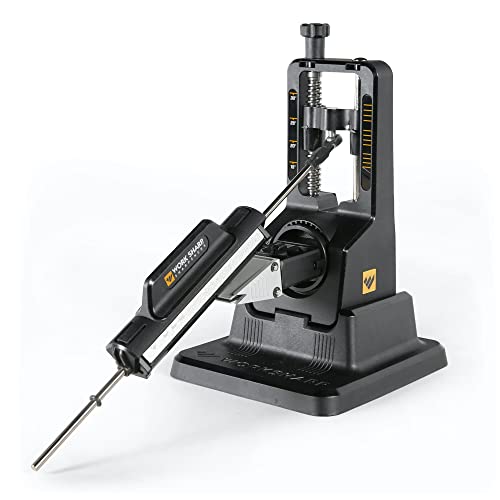
Work Sharp Precision Adjust Knife Sharpener
Best guided

Work Sharp Precision Adjust Knife Sharpener

The knife sits in a clamp and you set the angle from 15° to 30°, one degree at a time.

Buy it if

You have knives of different angles (a Japanese gyuto, a German chef's knife, a hunting knife) and you'll take your time to get each one right.

Skip it if

You want it over with before dinner. That's the Trizor.

Read the full write-up

Every knife at its own angle

The Precision Adjust holds the knife in a clamp and guides a rod at whatever angle you dial in, from 15 to 30 degrees in one-degree steps. The rod carries a three-sided handle: coarse diamond, fine diamond, fine ceramic. You stroke the edge with the coarse side until you feel a little lip of metal along the other side (that's the burr, and it tells you the edge is fully sharpened), flip the knife, do the other side, then turn the handle to the next grit.

Work Sharp says a set of abrasives lasts 200 to 300 sharpenings and sells replacements. Keep it dry; oil and water can make it rust. For a kitchen with one good chef's knife, this is more than you need. For a drawer full of mismatched knives, plus the pocketknife and the fillet knife, it's the most useful thing here.

What owners report

The clamp is the sore point. Quite a few owners found the blade shifting or pivoting in the jaws (a chef's knife and a santoku among them), and one measured a 4-degree difference after flipping it. About as many broke or lost small plastic parts; one had the cap on the end of the rod pop off a dozen times. The ones who got past the first sessions talk about shaving-sharp edges in 5 to 20 minutes, Global and Japanese kitchen knives included.

Flaws but not dealbreakers
  • It's a project the first few times, and the clamp needs checking after every flip.
Diamond 320 and 600, plus ceramicReplaceable abrasivesUsed dry3-year warranty
5
Work Sharp Rolling Knife Sharpener
Best rolling

Work Sharp Rolling Knife Sharpener

A magnet holds the blade at the angle you choose, and you roll a diamond disc along the edge.

Buy it if

You like the idea of sharpening as a calm little ritual, with no motor and no soaking, and your knives are kitchen-sized.

Skip it if

Your knives include a lot of small paring knives, or blades taller than about 2.25 inches.

Read the full write-up

Rolling sharpeners are everywhere right now, and this is the one I'd buy. You stick the knife to a magnetic block (it has 15, 17, 20 and 25 degree faces), set the roller on the counter beside it, and roll the diamond disc back and forth along the edge. Then you swap to the finer disc, then the ceramic one, each held on by a magnet. Outdoor Life put it first out of seven rolling sharpeners.

America's Test Kitchen gave up on two popular ones (the HORL 2 and the Tumbler) because the roller sat too low to reach the heel and the tip of a standard chef's knife. Work Sharp gave this one big 2.5-inch discs and says it handles blades up to about 2.25 inches tall. Anything narrower than half an inch won't sit well on the magnet, so the tiny paring knife may have to go elsewhere.

What owners report

Four owners found small knives sitting too low on the magnet: paring knives are fiddly, and on pocketknives the disc can touch the plastic. One steadies long chef's knives with his fingers because they flex away from the block. Four more wished for a coarser disc than the 320 for a really neglected edge. Others found it easy and very sharp, and one brought a nakiri back in 15 minutes.

Flaws but not dealbreakers
  • About $120, more than the Precision Adjust, for fewer angles.
  • The discs only fit this sharpener. Replacements come from Work Sharp.
Diamond 320 and 600, plus ceramicBlades up to 2.25 in tallReplaceable discs3-year warranty
6
King 1000/6000 Combination Whetstone
Best whetstone

King 1000/6000 Combination Whetstone

The classic Japanese starter stone, with an angle guide and a base in the box.

Buy it if

You want to learn to sharpen by hand, or you own Japanese knives you'd rather not put in a machine.

Skip it if

You want sharp knives tonight. A stone takes practice, and the first few edges won't be your best.

Read the full write-up

King stones come from Matsunaga in Osaka, and the 1000/6000 is the one people start on. The darker 1000 side does the sharpening and the pale 6000 side polishes. Soak only the 1000 side, for about two minutes, and just splash water on the 6000 (a finishing stone left in water can crack). The kit here adds a plastic base and an angle guide to help you hold the knife steady while you learn.

It's slow, but you end up knowing your knives. A stone also works at any angle you hold, including the lopsided edges some Japanese knives have. Practice on a cheap knife first, and keep a towel under the base (it gets wet).

Flaws but not dealbreakers
  • Messy. You'll want to do this by the sink.
  • King stones are on the soft side. They wear hollow in the middle, so plan on flattening yours now and then.
Size

The stone is about 7.5 by 2.5 inches and an inch thick.

Made in Japan1000 and 6000 grit7.5 x 2.5 inAngle guide included

Who this is for

This is for the cook whose chef's knife slides off an onion instead of biting in. If you already keep a stone and enjoy using it, you don't need a machine; a honing rod is probably all you're missing.

How to choose

Match the angle

15 degrees for Japanese knives and most newer ones, 20 for older German and American blades. Buy a sharpener that matches, or one that adjusts.

Electric or manual

Electric is faster and can repair a chipped edge. Manual is smaller, quieter and cheaper, and fine for an edge that's just a bit dull.

Serrated knives

The Trizor, the Pronto and the AccuSharp handle bread knives. Check before you buy anything else.

Sharpening or honing

A honing rod pushes a bent edge back in line and removes almost no metal. A sharpener grinds a new edge. Hone often, sharpen when honing stops working.

What I'd skip

Chef'sChoice 1520

The one to get if your drawer is a real mix of 15 and 20 degree knives, since it sharpens both. But it's about $190, and for most kitchens the Trizor at 15 degrees does the job for less.

Chef'sChoice 315XV

A cheaper Trizor, about $85, with two slots instead of three. Its edges don't last quite as long, so you're back at it sooner. A fair buy if $166 is too much and you want electric.

Work Sharp Professional Precision Adjust

The metal-bodied version with bigger abrasives and a digital angle gauge. Lovely, and about $250. The basic Precision Adjust gets a home cook most of the way for $70.

HORL 3 Cruise

A rolling sharpener with strong magnets that grip even small knives, about $119. Its diamond disc is fixed, though, so when it wears out you buy a new sharpener. The Work Sharp's discs come off and get replaced.

Tumbler Rolling Knife Sharpener

The rolling sharpener from all the ads, about $129. Its roller sits too low to reach the whole edge of a chef's knife, so the heel and the tip stay dull.

Presto EverSharp

An electric sharpener for about $69. Under a microscope its edge looks jagged, and it comes out sharper one time than the next.

Work Sharp E5

A push-button electric that runs a 90-second cycle on a belt, about $150. The edges can be excellent, but nothing in the slots guides the blade, so they vary from one knife to the next.

How I picked

A known angle, 15° fixed or adjustableDiamond abrasives, or carbide for a cheap touch-up toolA dull knife sharp again in minutesStores in a drawer or a cupboardReports from testers and owners on scratches, reach and wearOn Amazon US

These six came out of 24 sharpeners, from a $12 handheld to a $428 Tormek. Results come from America's Test Kitchen, Consumer Reports and Outdoor Life, owner reports from retailer and maker reviews. Prices are Amazon's on October 13, 2026.

Pinterest pin for The Best Knife Sharpeners
Save it for laterPin this guide and find it again when you are ready to buy.Save to Pinterest

Common questions

What is the best knife sharpener for home use?

The Chef'sChoice Trizor XV, if you want it done for you: about two minutes, no skill needed, serrated knives included. For a manual one, the Chef'sChoice Pronto at about $41.

What is the best type of knife sharpener for home use?

Electric, if you want sharp knives with no learning curve. A pull-through manual sharpener if you'd like something small and cheap for touch-ups. A whetstone if you want to learn the skill and control every edge yourself.

Do electric knife sharpeners really work?

The good ones do, and a well-made one doesn't take off more metal than a stone would. The trick is not to start in the coarse slot every time: for a knife that's only a little dull, the last slot alone is usually enough. Cheap models are another story, and some chew up the edge.

Is a whetstone better than a knife sharpener?

A whetstone gives you the most control and can sharpen any angle, including the lopsided edges some Japanese knives have. But it takes practice to hold the angle steady. A good electric or pull-through sharpener gets most home knives sharp much faster, though people who sharpen by hand say a stone still leaves a finer edge.

How often should you sharpen your knives?

When it starts skidding on an onion or tearing paper instead of slicing it, it's time. In between, a few strokes on a honing rod (or the last slot of an electric sharpener) keep the edge straight longer. What you cut on matters too: a glass board dulls a knife fast, and a wood cutting board is much kinder to it.

The verdict

Buy the Trizor XV. Learn on the King.

If you just want sharp knives, the Trizor XV at about $166 does it while the kettle heats. If you'd like to learn to sharpen by hand, the King stone costs about $44, and the skill stays with you.

More from Sunday Stove