Sunday Stove

The Best Meat Thermometers

Know the chicken is done without cutting into it, with picks from a $20 oven probe to a wireless one for the smoker.

By Nell Harlan · Updated Oct 9, 202639 thermometers compared

We earn a commission when you buy through our links, at no extra cost to you. How that works

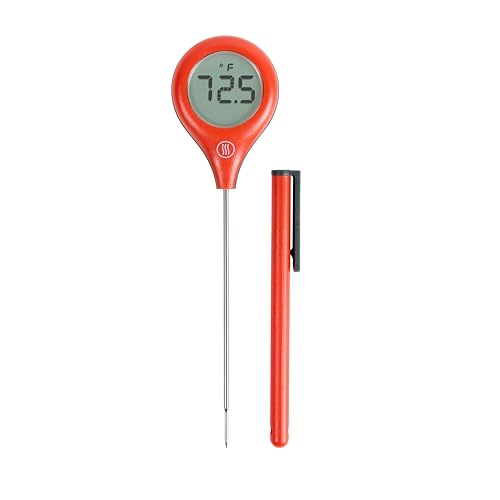
The Thermapen ONE is the meat thermometer to get. Slide it into a pork chop on the grill and the number is there before your hand starts to feel the coals. It costs about $125, which is a lot for a thermometer, and it's still the one I'd buy.

Less to spend? The ThermoPop 2 reads in two or three seconds and costs about $47. For a prime rib or a Thanksgiving turkey, add a probe that stays in the meat while it cooks. The DOT is the one I'd pick, and the TempPro (formerly ThermoPro) TP16 does the job for about $20. And if most of your cooking happens out back with the lid closed, look at the wireless MEATER Pro.

Our picks

Best overallThermoWorks Thermapen ONECheck price on Amazon
Best under $50ThermoWorks ThermoPop 2Check price on Amazon
Best leave-inThermoWorks DOTCheck price on Amazon
Best under $25TempPro TempTrack TP16Check price on Amazon
Best wirelessMEATER ProCheck price on Amazon

At a glance

  1. Best for
    Every steak, chop and roast
    Type
    Instant-read
    Reading
    About 1 second, ±0.5°F at cooking temperatures
    Power
    1 AAA, up to 2,000 hours
  2. Best for
    Quick checks for less
    Type
    Instant-read
    Reading
    2 to 3 seconds, ±1°F
    Power
    CR2032, up to 4,000 hours
  3. Best for
    Roasts and birds in the oven
    Type
    Leave-in, wired probe
    Reading
    Constant, ±1.8°F
    Power
    2 AAA, up to 5,000 hours
  4. Best for
    A leave-in probe for about $20
    Type
    Leave-in, wired probe
    Reading
    Constant, ±1.8°F
    Power
    1 AAA
  5. 5.MEATER Proabout $100
    Best for
    Grills and smokers
    Type
    Wireless probe
    Reading
    Constant, in the app
    Power
    Rechargeable in its case

The 5 thermometers, ranked

1 · Best overall
ThermoWorks Thermapen ONE

ThermoWorks Thermapen ONE

Accurate to half a degree, says ThermoWorks, and backed for five years.

Buy it if

You cook meat a few nights a week and want a number you can trust right away.

Skip it if

You mostly cook on a smoker and want to follow the meat from the couch. That's a job for a wireless probe.

A reading in about one second

America's Test Kitchen still ranks it first among instant-read thermometers. In their trials it took 1.1 seconds on average and stayed within 0.07 degrees at 125°F, where other models drifted up to 2 degrees off. ThermoWorks rates it at ±0.5°F at cooking temperatures. Because it's so quick, checking a pork tenderloin in two or three places takes no longer than one reading with a slow thermometer.

The screen turns itself so the numbers are right side up, and the backlight comes on by itself in the dark. There's no power button. Pick it up and it turns on. It runs on one AAA battery and it's IP67 waterproof, so you can rinse the probe under the tap.

It comes in a few colors at the same price. I'd get the red.

What owners report

Several of the newest reviews come from people replacing an older Thermapen. One whose Classic finally quit was glad to switch to a plain AAA battery, and a competition barbecue cook says he wouldn't show up to a cook-off without one. The one mild complaint comes from a longtime Mk4 owner (it lasted ten years, until a trip through the dishwasher) who finds the ONE a little wider, with a shorter probe.

Flaws but not dealbreakers
  • Hey Grill Hey found the battery runs down a little faster than in other ThermoWorks models.
IP67 waterproofAuto-rotating screenAutomatic backlight5-year warranty
2
ThermoWorks ThermoPop 2
Best under $50

ThermoWorks ThermoPop 2

The same company's cheaper one, waterproof and good for 4,000 hours on a coin cell.

Buy it if

You want a thermometer from the same company as the Thermapen and don't need the fastest one.

Skip it if

You check six burger patties in a row on a busy night. Those extra seconds add up.

Read the full write-up

America's Test Kitchen made this its Best Buy. It averaged 2.6 seconds per reading in their trials and came within 0.2 degrees in ice water, and ThermoWorks rates it at ±1°F between 14°F and 208°F, which covers anything you'll cook for dinner.

There's one button, on the back, and it does everything: on, off, light. The round screen rotates so the numbers are right side up in either hand, and it lights up for ten seconds when you press. ThermoWorks also makes it with an 8-inch probe. The one here has the 4.5-inch probe.

What owners report

Two of the ten newest reviews come from people on their second one. One owner's first ThermoPop lasted almost nine years, and the other dropped theirs into the grill. The two lukewarm reviews wanted things it doesn't have: an alarm, and a pot clip for candy.

Flaws but not dealbreakers
  • The body is small. America's Test Kitchen wished it were a bit bigger to hold.
  • It turns itself off after 10 minutes, so don't count on it for anything you want to watch for a long time.
IP67 waterproofOne buttonBacklit screen2-year warranty
3
ThermoWorks DOT
Best leave-in

ThermoWorks DOT

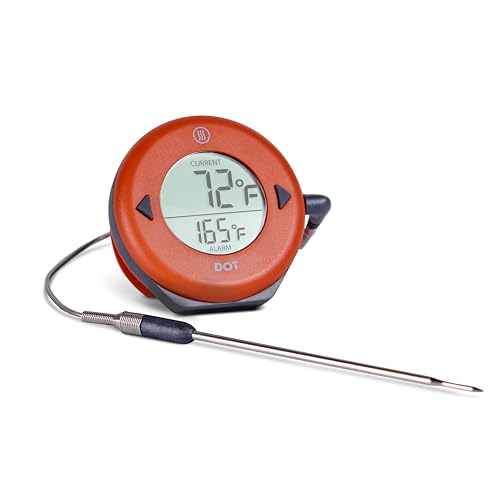
Set a number, close the oven, and wait for the beep.

Buy it if

You roast a chicken, a pork shoulder or a prime rib, and you'd rather wait for a beep than open the oven every 20 minutes.

Skip it if

You want a timer or a low-temperature alarm on the same box. The DOT has a high alarm and nothing else.

Read the full write-up

Push the probe into the thickest part of the meat, run the 47-inch cable out the oven door (ThermoWorks rates it to 700°F), and stick the box to the side of the range with its magnets. You set the target with the up and down buttons. The screen shows the meat's temperature next to your target, and a 70 dB alarm goes off when the meat gets there. I'd hand this one to anyone cooking their first big roast.

ThermoWorks puts it at ±1.8°F, and in America's Test Kitchen's trials the alarm went off as accurately as the one on their winning leave-in model. Two AAA batteries last up to 5,000 hours.

What owners report

Owners use it for a lot more than roasts. People grill thick pork chops with it, a pellet-smoker owner finds its probe more accurate than the ones that came with the smoker, and a home inspector uses it to check that ovens actually heat to what the dial says. The newest reviews don't mention a single problem.

Flaws but not dealbreakers
  • The box is rated for splashes, but the jack where the probe plugs in isn't covered by that rating. Keep it dry.
  • The pot clip and grill clip are sold separately.
47-inch cableCable rated to 700°FMagnetic back70 dB alarm
4
TempPro TempTrack TP16
Best under $25

TempPro TempTrack TP16

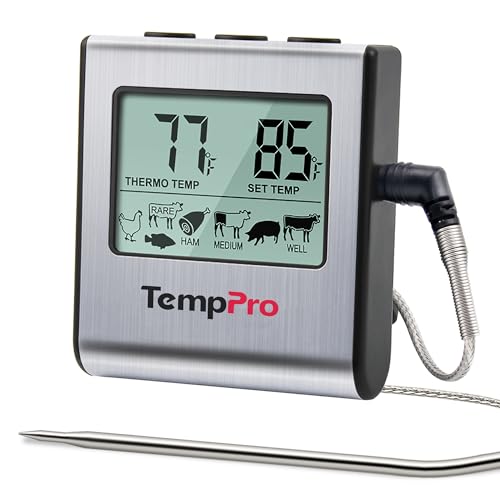
A probe that stays in the roast, with a timer and meat presets, for about $20.

Buy it if

You want a probe that stays in the roast, and you don't want to spend more than $20 on it.

Skip it if

You want the timer and the temperature on screen at once. You flip between them with a switch on the back.

Read the full write-up

America's Test Kitchen named the TP16 the Best Buy among leave-in thermometers and called it one of the most accurate they tried. They liked the angled probe too, which makes it easier to aim into the middle of a roast.

It comes with presets for different meats, and you can change every one of them. The timer runs up to 99 hours, enough for a pork butt in the smoker. The box has a magnet, a stand and a hole to hang it. ThermoPro now sells under the name TempPro, so your box may still say ThermoPro.

Flaws but not dealbreakers
  • No low alarm, so it won't warn you if the smoker's fire dies down.
Meat presets you can changeTimer up to 99 hoursMagnetic backBacklit screen
5
MEATER Pro
Best wireless

MEATER Pro

No cable at all, and an app that tells you when to pull the meat and how long to rest it.

Buy it if

You cook on a grill or a smoker, where a cable just gets in the way, and you don't mind checking your phone.

Skip it if

You want to read a number without unlocking your phone. The MEATER has no screen; everything goes through the app.

Read the full write-up

Just a probe, and your phone

The whole thermometer is one slim steel probe with six sensors inside. It goes in the meat and stays there, whether that's a whole chicken or a brisket in the smoker. MEATER rates it for 1000°F. Push it in at least as far as the line etched on the probe. That's where the sensors need to be.

Between cooks it lives in a magnetic bamboo case that charges it, and BBC Good Food found five minutes in there gave enough charge for a two-hour cook. The probe goes in the dishwasher, which you'll appreciate after a rack of ribs. If you want to follow two cuts at once, the two-probe Pro Duo costs about $180.

What owners report

Only three recent reviews are about this exact model, and all three report a problem. One owner's probe died after six months, and so did the replacement. Another's stopped holding a charge for more than a few minutes after a few weeks, and MEATER sent a new one. The third got wrong readings of the air around the meat.

Flaws but not dealbreakers
  • At the start of a cook, the time estimate takes a while to show up.
  • About $100 for one probe, which is a lot next to a $20 probe on a cable.
Six sensorsRated to 1000°FDishwasher-safe probeBamboo charging case

Who this is for

If you've ever cut into a chicken breast to see whether it's done, start with an instant-read: the Thermapen if you cook most nights, the ThermoPop if you don't. If you already own a fast instant-read, what you're probably missing is a probe that stays in the oven. And if the thermometer in your drawer has a dial and takes forever to settle, that's the first thing to replace.

How to choose

Instant-read or leave-in

An instant-read gives you a number in a few seconds whenever you ask: steaks, chops, burgers, chicken breasts, a salmon fillet. A leave-in probe sits in the meat and beeps at your target, which is what you want for a whole bird or anything that cooks for hours. Most kitchens need the instant-read first.

Pay for speed

Every second the oven door or grill lid is open, heat escapes and the cook slows down. America's Test Kitchen's slowest models took more than 11 seconds. Look for 3 seconds or less.

A probe long enough for a roast

America's Test Kitchen likes a probe of at least 4 inches. They found a 2.8-inch probe too short to reach the center of a thick roast.

Wired or wireless

A probe on a cable is cheap and simple, and the box beeps by itself. A wireless probe has nothing to pinch in the door or tangle on the grill, but you'll read everything on your phone and charge it between cooks.

What I'd skip

ThermoWorks Classic Thermapen

About $105, so only about $20 less than the ONE, and it's slower (2.8 seconds on average for America's Test Kitchen) with no backlight. That matters outside at night.

ThermoPro TP03

A cheap instant-read that America's Test Kitchen didn't recommend. It's accurate but averaged 11.6 seconds, takes three steps to turn on, and its battery door slid off during use.

Lavatools Javelin PRO Duo

America's Test Kitchen's midprice pick at around $40, and it reads in around 3 seconds. The handle is slippery, though, and the single button didn't always respond. The ThermoPop costs about the same.

Polder Classic In-Oven Thermometer

A leave-in probe for about $23, but it tops out at 392°F, so it can't keep track of a 450°F oven. The TP16 costs less and goes higher.

MEATER Plus

The previous MEATER, about $80. Hey Grill Hey reports accuracy and connection problems with it, and for $20 more the Pro is the newer probe.

Combustion Predictive Thermometer

A wireless probe with eight sensors, made to predict when the meat will be done, at about $180. Hey Grill Hey still calls connection the weak spot, and that's a lot of money for a doubt.

How I picked

Instant-read in 3 seconds or less±2°F or better, per the makerLeave-in probes rated for the oven and grillOwner reports on durability and connectionIn stock on Amazon US

I chose these five from 39 thermometers, from a $15 instant-read to a $259 kit for smokers, on speed, accuracy, and how they hold up for the people who own them. Owner reports come from ThermoWorks' store and Trustpilot. Prices are Amazon's on October 9, 2026.

Pinterest pin for The Best Meat Thermometers
Save it for laterPin this guide and find it again when you are ready to buy.Save to Pinterest

Common questions

What temperature should meat be when it's done?

The safe minimums from FoodSafety.gov: 145°F for beef, pork, veal and lamb steaks, roasts and chops, followed by a 3-minute rest. 160°F for ground meat and sausage. 165°F for chicken, turkey and all other poultry, whole or in parts, ground included. Fish is 145°F, or cooked until the flesh is no longer translucent and separates easily with a fork.

Can I use a meat thermometer for salmon?

Yes, any thermometer here works on fish, and FoodSafety.gov's number for salmon is 145°F. A fillet is thin, so do what the USDA suggests for thin foods: push the probe in from the side until the tip sits in the center.

Do you leave a meat thermometer in the meat while it's cooking?

Only if it's made for it. The DOT, the TP16 and the MEATER Pro are meant to stay in the meat in the oven or on the grill. The Thermapen and the ThermoPop are for quick checks: pull the meat out (or open the lid), take the reading, and take the thermometer out again.

Which is better, ThermoPro or ThermoWorks?

For instant-reads, ThermoWorks: the Thermapen ONE and the ThermoPop 2 were America's Test Kitchen's winner and Best Buy, and ThermoPro's TP03 was among the ones they didn't recommend. For leave-in probes, the gap disappears. ThermoPro's TP16 was their Best Buy, at about a third of the DOT's price.

How do I check if my meat thermometer is accurate?

The USDA's ice water test: fill a large glass with ice, add water, stir, and put at least 2 inches of the probe in without touching the glass. Wait at least 30 seconds and read it with the probe still in the water. It should read 32°F.

The verdict

The Thermapen ONE, and a probe for the big roasts

Get the Thermapen ONE and you'll stop guessing at the stove and the grill. Spend less with the ThermoPop 2 and you give up a second or two per reading. When you start roasting big cuts, add the DOT.

More from Sunday Stove